Week 1

Below are some thoughts broken down by topic:

Pain: They say no pain no gain right? But actually, I felt little to no pain in my knee the first day after surgery. I didn’t take any more narcotics after the day of surgery and was able to tolerate any discomfort. There was much less pain than the last surgery despite doctors saying that it would be much worse this time around…perhaps my body reacted very well to it. At Day 4, I would dangle my legs over the bed to see what angle they were at and at that time it was roughly at 70 degrees. If I forced it anymore I would feel a slight tightness. So my ROM starting off was fairly high. Meanwhile, I started working from home the day after surgery.

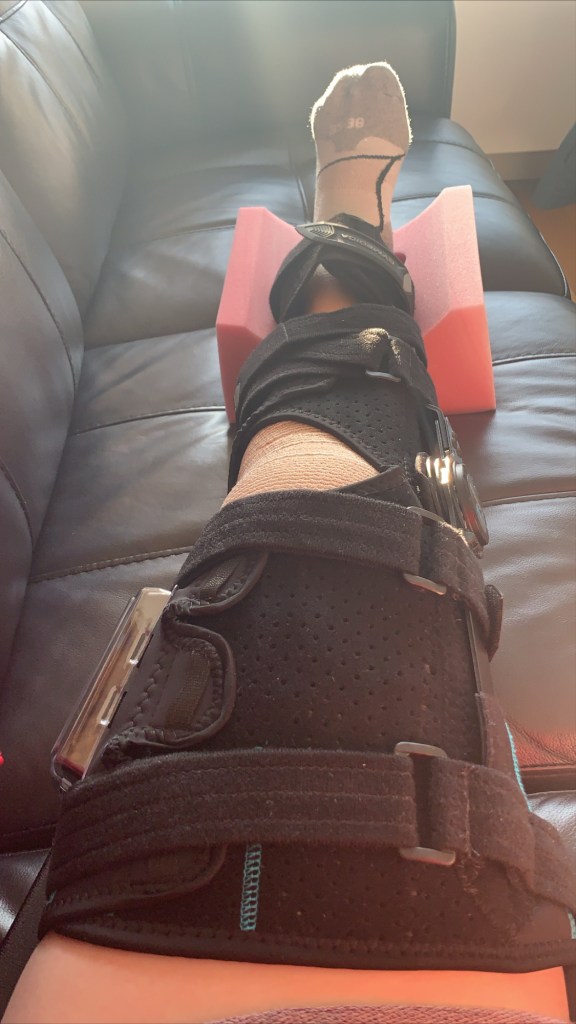
Getting around: I started off by moving around with 2 crutches with minimal weight on my left leg (~20% body weight). Going to the bathroom and showering were definitely the hardest parts. It’s important to get a stool or trash can to keep your leg raised and straight while you use the restroom. For showers, in the beginning I wrapped my entire leg (with my brace) with saran wrap and stepped into the shower. I preferred standing to sitting because bending my knee hurt a bit more. These showers were quick.

Cryotherapy: I made sure that I iced 30mins every couple hours. I had a cryotherpay ice machine for night time so I could leave it on low and sleep. This has done wonders for my knee in terms of swelling and pain. I’ve noticed swelling has gone down towards the end of the first week and I exhibit almost no pain.

E-stimulus: I started using the e-stimulus that came with my brace on Day 3. There were two pads for the thigh and one for the knee. I made sure that it would cause my thigh and knee muscles to contract. I would do this for 20 mins/3x a day.

CPM Machine: I started using the CPM machine on Day 3. The protocol said to do 0-30 degrees and by week 3 reach 90 degrees. I would add 5-10 degrees per day depending on how my knee felt. I would exhibit slight tightness as I angled higher towards 40 degrees on day 5 and 6. My doctor recommended that I do CPM for 6-8 hours a day (although this is an ideal…this is very difficult to accomplish while you’re also working from home). I tried to hit roughly 3 hours a day. My knee didn’t flare up or hurt after using the machine and I felt the range of motion increase every day. By day 7, I was up to 50 degrees.

Therapy Exercises: I saw my PT on Day 5 and we went over standing leg lifts to build the hips. We also went over exercises to engage the quads primarily squeezing the quad muscle. The first few were super weak and it was clear that my muscles had atrophied but after a few rounds the muscle memory started coming back.
Exercises:
5x 5 quad squeezes (leg straight, put thumb and index on either side right above kneecap, squeeze quads and feel the squeeze in your fingers)
3x 10 leg lifts (side/back/front) while standing with hands on the counter for balance
3x 10 weight shift from left to right (practice having 50-75% bodyweight on injured leg)

Diet: This is the cool part – because of this surgery I’ve completely changed my diet. Perhaps after surgery I didn’t have such a great appetite so it was easy to transition into a more plant-based diet. I read articles and documentaries on what to eat to have the speediest recovery and all were pointing towards a plant-based diet. I’ve eliminated all meat from my diet and will only eat some fish/eggs from time to time but everything else consists of vegetables. I’ve also kept my carb intake to a minimum seeing as I am unable to do much exercise. The results have actually been amazing (as I am writing this in week 2) I’ve noticed that I have more energy and I’m not as hungry. Even being at home and laying around I don’t have the need to snack. And instead of gaining post surgery weight, I’ve actually lost a few pounds. The goal moving forward is to fully transition into a plant-based diet.

Sleeping: Sleep has been rough at times, especially if the brace bothers me. Not being able to turn very well onto my sides means that I’m always sleeping on my back. I get roughly 8 hours of sleep per night (in bed around 10pm and am up around 5:30am). As noted above, I have the ice machine running when I fall asleep and turn it off when I wake up in the middle of the night. Another 5 weeks with this brace…

Mental/Emotional: To be quite honest, this recovery has taken a greater toll on me mentally and emotionally. I feel like the physical aspect may be the easiest to recover from. It’s definitely hard to be stuck at home when I used to only go home to sleep. I’ve always done a lot of activities and been social/active so not being able to go out definitely took a toll on me. I’d be lying if I said there weren’t days where I just woke up in a bad mood and grumpy because I knew I couldn’t go outside. Over the weekend, I had some friends visit which helped a lot. It is SO important to have your friends and family visit – this will give you your support system and make you feel like you’re not alone.

Thoughts: Not being able to move around with the independence you once had is difficult but you have to accept that it is part of the process. I saw a dramatic change in how I was able to accommodate myself to my needs from Day 1 to Day 7. It’s amazing how humans are able to adjust themselves to whatever situation they are in. It’s imperative to stay positive – aside from working, I read more and took some online classes. I started journaling my progress just to clear my head and take note of everything that I was going through. This was definitely difficult to accept at first but the future seems bright and once I regain my full ROM I know that I can perform even better than I used to. Remember…trust the process.
Day of Surgery Part 2

On February 3rd, 2020, I had the second part of the 2 part MACI knee surgery. Standard pre-surgery procedures applied (no food and liquids after midnight, no clear liquids (water) 3 hours prior to surgery).

Before being pulled into the pre-procedure changing area, a physical therapist pulled me aside and went over instructions on how to walk with crutches. We adjusted my crutches and went up and down the stairs. This surgery would consist of using a CPM (continuous passive motion) machine for the first few weeks, and PT also showed me how to use that. After going over these instructions I was taken away by nurse to prepare for surgery.

An athletic trainer came by and showed me my brace (Cymedica Orthopedics). The brace comes with a e-stimulus for VMO/quadriceps muscle re-education. He leaves the brace with me and tells me to make sure that I go into the OR with it (lol)

There are two different types of anesthesia for this surgery – regional and general. Regional anesthesia would be like an epidural and cause the lower body to go numb. I opted to do general anesthesia and go under completely.

I woke up very groggy in the recovery room. They immediately gave me another dose of Percocet. I didn’t feel that much pain and to be quite honest, I felt less pain after this surgery than I did with the first one. It was later revealed to me that my surgeon had injected a concoction of meds into my knee which would last for the next 48-72 hours (I guess when it technically should hurt the most). I think that having my knee locked straight in a brace also helped alleviate the pain because I couldn’t really put any pressure/move it like I did the first time around.

Since it was an outpatient procedure, I got home around 5pm and was nauseous and dizzy. On a scale of 1-10 my pain was at roughly 2/10 and I knocked out for hours to recover from the anesthesia. I slept really well in the brace that first night – from 8pm to 7am the next morning. I woke up the next morning refreshed with little to no pain.

Important: I was told that I did not have an osteotomy which meant that I could bear weight fully on my injured leg (full extension locked brace) as much as I could handle. This solely depends on the location of the graft which is determined during surgery. If it was an osteotomy, then there would be minimal weight bearing allowed for a the first couple weeks.

4 hours post-op with full leg brace

Surgery Part 1 & Post-Op

On December 10th, I had the first part of the 2 part MACI knee surgery. The goal of this was to remove the broken pieces of cartilage, take a biopsy of my cartilage and grow it in a lab to be implanted a few weeks later.

What actually happened was:
-broken pieces were removed
-biopsy was taken
-bones were cleaned (due to the breakage there were a lot of frays)
SURPRISE: I had a slight tear in my meniscus
**this wasn’t captured in the MRI and the surgeon saw it while performing my knee arthoscopy. Unfortunately the tear was in a place where there was no blood flow so there was no point in fixing it since it wouldn’t have healed.

This surgery was done via knee arthoscopy, so there was supposed to be minimum scarring since the incisions were less than half an inch on both sides of the knee. While the incisions were not big, the amount of work that was done inside the knee caused it to have a lot of swelling.

Post op – I felt like there was more pain than I had expected. Most people kept telling me that knee arthoscopy was a minimally invasive and easy surgery to recover from, but it was hard for me to move my knee afterwards and the swelling took several weeks to really go down. During this time I consistently did PT twice a week.

The course of treatment started with multi-dimensional patella mobilization (manual movement of the kneecap to keep the fluid in the joint moving). In order to build muscle around the hips we used a ball to do hip raises (less pressure on the knee). As the days went on we started going into straight leg raises and added weight to these straight leg raises. I had to relearn how to use the stairs by alleviating the pressure on my knee which meant that every time I put pressure on my left knee going up the stairs, I would push my knee outwards.

For the next few weeks as we prepared for surgery part 2, we began to build balance and strength. We did knee extensions with exercise bands and the crab walk. It was imperative that I build my hip and quad strength prior to surgery as it would help me immensely with “bouncing back”. By the end of the 6 weeks, I was able to do 50lb kettlebell deadlifts! I hadn’t felt that good in so long but knew that the road to recovery from part 2 was going to be a long one.

Typical session:
Stretch and roll out IT band/quads/glutes
3x 10 one leg step up/down (leading with the injured knee)
3x 15 knee extension with band
3x 10 crab walk with band (each leg)
3x 10 single leg Romanian deadlift with 10-15lbs
3x 10 50lb kettlebell deadlifts

I developed a better understanding of how my body moved and was able to use my hips more in daily activities so that most of the strain wouldn’t be on my knees.

Advice
To prepare for surgery I’d say the best thing to do is to become as strong as you possibly can. The stronger you are going into surgery the faster your recovery. The first surgery is the easy part. The second one will take much longer time to recover and you won’t be able to do the same exercises you once did for at least a month. Your muscles will definitely start to atrophy so it’s important to have a strong foundation before going into the OR.

Background & Injury

The purpose of this blog is to record the emotional/mental/physical trials and tribulations throughout my journey to recover from MACI knee surgery. These entries serve as a way for me to process my thoughts and heal not only physically but mentally. Hopefully it will also provide some color to someone else who will be embarking on this journey 🙂

Now a little about myself and what happened…
Growing up I’ve always loved to play sports – especially basketball. Throughout my teens, you could always find me after school on the court shooting hoops. It was an escape from the world. Over time, life and responsibilities got in the way, and I stopped going on the court and my life got more sedentary.

I wanted to change that so starting in 2018, I started being more active. I participated in HIIT classes (Switch Playground!) and boxing classes. I had gotten out of my slump and was feeling happier and lighter. I started going back to basketball and ended up joining Zogsports for a bball league in 2018.

Around June 2019 in the middle of one of my Switch classes, I felt some left knee pain when I squatted. I chalked it up to fatigue and bad posture and continued on. The pain didn’t come back so I carried on. A few days later while I was doing another class, my left knee started to bother me a lot to the point where I had to ask the trainer to give me other exercises due to the injury. I still didn’t think much about it and bought a simple knee brace to put on while doing exercises. I started to notice that over the course of two weeks, stairs started to hurt. Boxing started to cause me pain too. But being someone who has had a few surgeries in the past I thought I could overcome the pain and I was waiting for my knee to naturally get better.

In mid July I stepped on the basketball court with a friend of mine and after a couple hours of shooting hoops my knee pain had hit the worst it’s been all summer. I was going to the Balkans in a week and knew that if I didn’t get it checked, I wasn’t sure if I could make it through the trip. The first orthopedic surgeon I went to said that I had a tight IT band which was causing me the knee pain. He gave me a cortisone shot to help relieve the pain and swelling on my trip. I did my best to avoid stairs and brought a hiking stick with me to help me get around. But after a few days, as the steroids were kicking in, I suddenly felt much better.

After coming back from vacation I started going to physical therapy to relieve my IT band tightness. Despite all the PT I did, my knee was still hurting (although less than it did before) and I was not showing any signs of a pain free life. I wanted to get back to what I used to do and it didn’t seem like it was getting any closer.

In November I went to Vegas on a bad knee to a music festival (prob wasn’t a great idea). With all the hype around me, I ended up raging just like everyone else and I remember a specific moment that night when Future was playing and after I landed on my feet I felt a pop in my knee. My knee start cracking and buckling and I endured the next couple days of the festival with a knee brace. The pain wasn’t much worse than what it had been before, but now it felt like my kneecap kept giving way.

After getting back from the festival I decided to find another orthopedic surgeon and that’s where I met Sabrina Strickland from Hospital of Special Surgery. After taking a MRI and X-ray, she said that I had broken off a piece of my cartilage on my kneecap and there were floating pieces around (which explains why my knee kept having the sensation of getting “caught”). I had to have those pieces removed. But the second part was what I was dreading. She said that because the missing cartilage was right where my knee rubbed my thigh bone, it was best if I did a MACI surgery (Matrix-induced autologous chondrocyte implantation) to repair the missing piece of cartilage. So this would involve two surgeries 1) to remove broken cartilage and take a small piece for biopsy to grow in a lab 2) cartilage graft.

Reasons behind why I decided to get MACI:
-25 years old
-Want to go back to boxing/HIIT/baksetball and competitive sports
-Didn’t want a knee replacement at the age of 40
-Algorithmic trader by trade so it was a sedentary job that I knew I could work from home in the beginning of recovery
-Recovery would take up most of winter which was ideal due to NY weather

And just like that, I scheduled my first surgery for December 10, 2019